
A local patch with hand-applied cementitious repair mortar replaces a small area of loose or shallow damaged concrete. The contractor removes weak material, prepares a bondable substrate and applies a suitable mortar with a trowel. This method is most useful for shallow surface repairs to, for example, a wall or column. It does not automatically restore a structure’s load capacity or repair deteriorated reinforcement. [1, 2]
Assess the cause and extent first
A spalled area may result from impact or wear, but also from corrosion, freeze-thaw damage or chemical attack. Inspection, sounding and, if needed, further investigation can help establish whether concrete is loose beyond what is visible. If reinforcement is exposed, rust is present or section loss is suspected, a simple cosmetic patch is not an adequate starting point. The extent of deterioration, reinforcement condition and any effect on structural function need assessment. [1, 2]
Which method suits the location?
- Hand-applied repair mortar. Suits shallow, local repairs to accessible horizontal, vertical or overhead surfaces. It needs relatively little equipment, but the mortar must suit the orientation, layer thickness, exposure and substrate. Other placement methods are often more suitable for a larger or deeper cavity. [1]
- Form-and-pour or form-and-pump. May suit deeper cavities, larger cross-sections or repairs around reinforcement where material must flow into a contained space. Formwork and placement openings require extra preparation; flow and consolidation must be controlled to avoid voids. [3]
- Shotcrete. Can reduce formwork on larger vertical or overhead repair areas, but requires suitable equipment and specialist application. It is not the automatic choice for one small patch. [4]
This example uses a small, shallow wall patch applied by hand. It is the clearest variant for showing the relationship between a prepared cavity, mortar contact with the substrate and the finished surface. This choice is not a prescription for a particular damaged area.
How is a hand-applied patch installed?
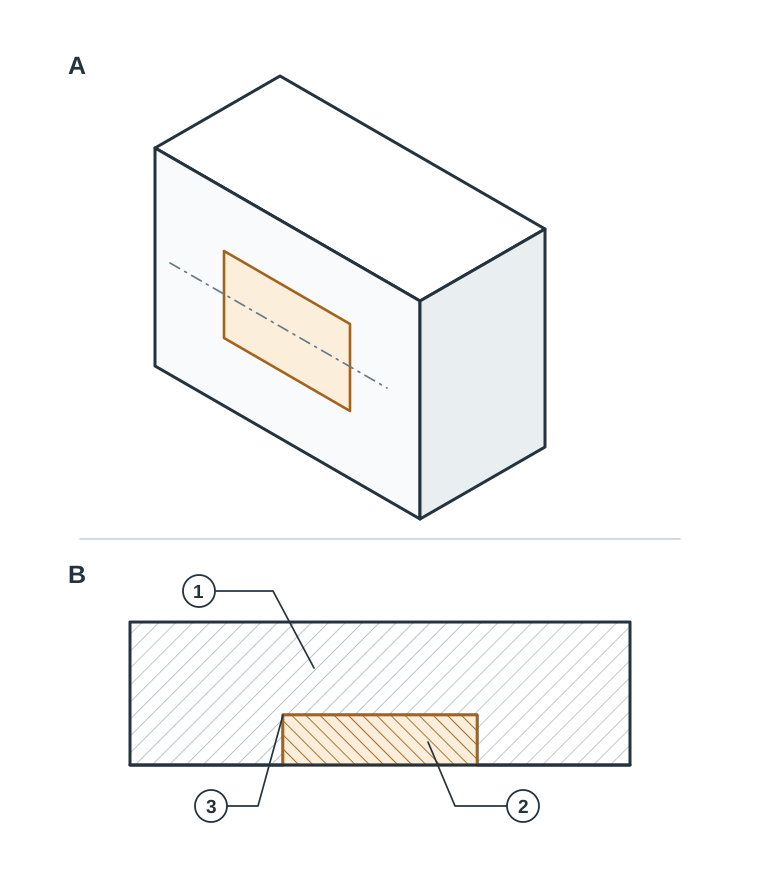 A shows the finished wall patch. B is a horizontal section at the dashed line.
Legend · 1. Sound existing concrete · 2. Repair mortar · 3. Edge of the prepared recess
- Mark and remove. Set the repair boundary from the assessment and design. Remove loose or delaminated concrete until the remaining substrate is sound. A simple shape with clear edges helps avoid thin feather edges. Required depth and edge treatment depend on the design, product and substrate; do not saw to a fixed depth without checking.
- Prepare the substrate. Remove dust, loose particles and contamination, and achieve the specified roughness and moisture condition. Cementitious mortars often require a pre-wetted surface without standing water; some systems specify a different condition or a bonding agent. Follow the technical product instructions and repair specification.
- Mix and place mortar. Measure water and components as specified. Press mortar into contact with the substrate and consolidate it into corners. If multiple layers are needed, apply the next layer at the specified time and with suitable interlayer bonding.
- Finish and cure. Finish the patch without feathering its edges to a thin film. Protect and cure the repair as required for the mortar and site conditions. Rapid drying can contribute to cracking or bond problems.
Required layer thickness, bond coat, moisture condition, mixing and working time, curing and return-to-service timing vary by product and project. The contractor should match product selection, preparation and curing to the existing concrete and service conditions.
Where is the boundary with structural repair?
A thin hand-applied patch can restore the surface and local cover, but it should not be equated with restoring load capacity. If damage extends deeper, bars have deteriorated or the section, load transfer or stability is affected, a structural engineer should assess the repair. The engineer may specify additional reinforcement, a larger repair volume, formwork, shotcrete or another structural measure. A local repair without investigation may also leave surrounding deterioration active or create new problems at the interface between old and new concrete. [1, 2]
How do you assess the patch?
Photograph and record the location and extent before and after repair. During the work, check that the substrate is accepted, mortar is mixed and placed as specified, and curing is carried out. After curing, sounding may indicate hollow or debonded areas, but it is not a complete bond test. The specification may call for additional checks such as pull-off testing. Acceptance methods and criteria should be stated in the project plan beforehand. [1]
Ask the contractor what concrete was removed, how sound remaining concrete was established, which mortar was selected and why, how moisture and curing are controlled, and what checks are included at handover.
See also repair and protect reinforcement, concrete surface preparation and the contractor directory.
Sources
- ACI Committee E706, Vertical and Overhead Spall Repair by Hand Application, ACI RAP Bulletin 6, 2020 edition, reapproved 2019, PDF pp. 3–8: applications, cause and objective, removal to sound concrete, edge and substrate preparation, material choice, lifts, curing and checks. PDF · ACI publication page. US field guidance, not a local work specification.
- STRRES, Reprise des bétons dégradés, Guide FABEM 1, Version 2, December 2021, §§3.5.2.2–3.5.2.3, pp. 136–137 (surface repairs and hand-applied mortar as one of several methods); §3.4.6.3.4, pp. 107–108 (risks of local repair in corrosion damage without prior investigation); Table 26, p. 218 (methods by repair purpose). PDF · guide page. French guidance; NF P95-101 applies in the French context described.
- ACI Committee E706, Surface Repair Using Form-and-Pour Techniques, ACI RAP Bulletin 4 (2003, reapproved 2009), PDF pp. 3–5: formwork, placement behind forms, use around reinforcement, benefits and added labor. PDF · ACI publication page. ACI RAP-5: Surface Repair Using Form-and-Pump Techniques.
- ACI Committee E706, Concrete Repair by Shotcrete Application, ACI RAP Bulletin 12, 2010, PDF pp. 3–5: pneumatic placement and use on vertical/overhead surfaces; requires suitable application equipment and preparation. PDF.