
The right approach starts with the problem to be solved, not a product name. First assess the condition and cause; then compare objectives, possible methods and their limits. A material or construction method is suitable only when it fits the substrate, exposure, access and required performance. [1, 2]
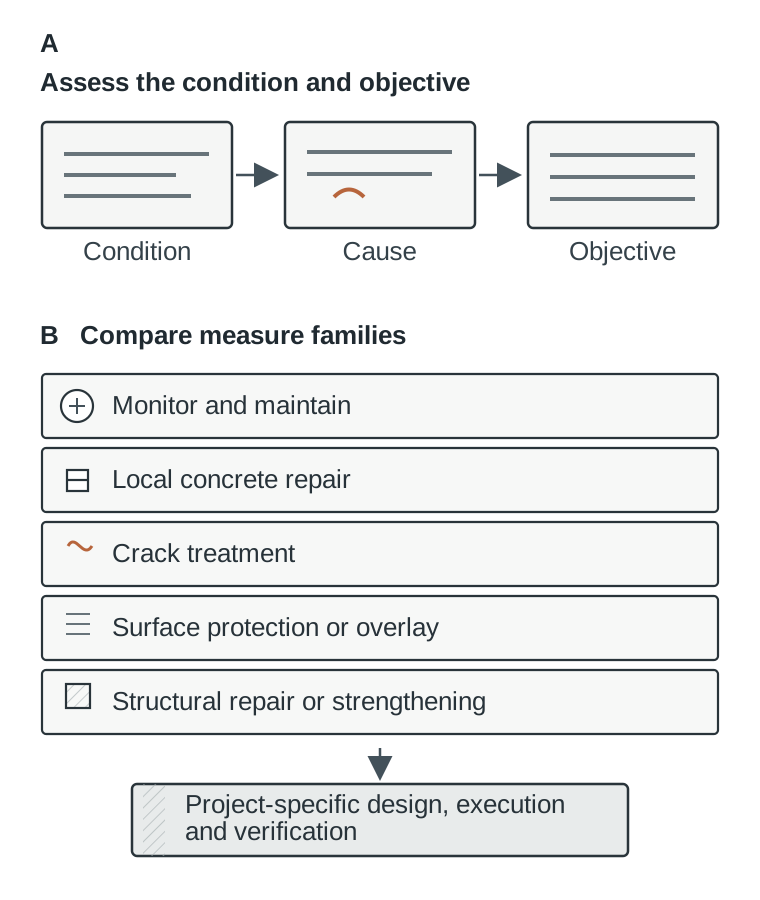
Figure 1. Schematic route from assessment to a measure. The result is not an automatic choice; options must be assessed for the specific structure. Not to scale.
1. Establish the condition
Gather drawings, earlier reports, maintenance history and information about use and exposure. Record visible defects and relevant measurements. Then investigate which mechanisms may explain the damage and whether the visible area represents its full extent. A crack, spall or damp patch is not enough to select a method: concealed deterioration, reinforcement, water exposure and structural function may change the decision. [1, 4]
If there may be a hazard, load-carrying function is in question, or strengthening could be needed, a qualified structural engineer should lead the structural assessment and design. A surface repair cannot restore lost capacity by itself. [1]
2. Define the objective
A measure may aim to manage an immediate risk, restore function, limit further deterioration, reduce leakage, restore a surface or improve appearance. Also state the intended service life, future inspection needs and consequences of taking no action. Not every visible irregularity requires repair; monitoring or planned maintenance may be appropriate if the structure continues to meet agreed requirements and the cause and risks are controlled. [3]
3. Compare families of measures
| Measure | When it may fit | Limits and verification |
|---|---|---|
| Monitoring and maintenance | When investigation does not justify immediate intervention and change can be tracked | Set a baseline, inspection interval and action criteria; monitoring does not repair anything |
| Local concrete repair | For a defined area where damaged or deteriorated concrete is removed and replaced | Cause, extent, reinforcement, substrate and interface with existing concrete must be considered; execution checks and suitable acceptance criteria are needed |
| Crack filling, injection or sealing | When the objective and crack behaviour are understood, such as structural repair or limiting water flow | These techniques have different purposes; movement, moisture and crack condition affect suitability and verification |
| Surface protection or overlay | When a surface needs protection, a new functional layer or reduced ingress | Defects and substrate must be suitable; bond, compatibility, details and maintenance affect performance |
| Structural repair or strengthening | When load capacity, stiffness or structural continuity must be restored or increased | Requires assessment and project-specific design; temporary support, connections, execution and structural verification may be needed |
The table names families of measures, not a ready-to-use specification. One repair may combine several objectives, for example concrete replacement with protection or corrosion control. Addressing the cause remains important: a new surface alone may not stop a process within the structure. [1, 2]
4. Select material and construction method next
Only after choosing the objective and measure family should materials and construction methods be compared. Project questions include repair depth and shape, horizontal or vertical orientation, access, temperature and moisture, existing concrete properties, bond, shrinkage, deformation, chemical and freeze-thaw exposure, appearance, work window and disruption to use. Relevant material properties vary by application. A higher strength value alone does not make a repair material more suitable. [2]
The placement method is also part of the design: hand application, casting behind formwork, pumping and shotcreting have different requirements. Consider concrete removal, temporary support, reinforcement protection, preparation, curing and future inspection access. The responsible designer should define requirements and acceptance criteria before bids are compared.
5. Decide how the result will be checked
Connect each requirement with a check. This may cover the extent and depth of removal, condition of retained concrete, reinforcement position and treatment, layer thickness, material records, environmental conditions, curing, bond or watertightness. Visual inspection can identify many construction deviations, but it does not confirm every performance requirement. A pull-off test, measurement or structural check is useful only when it addresses the stated question and has agreed criteria. [1, 2]
Ask the designer or contractor: what is the objective, which cause does the measure address, what alternatives were considered, how was material compatibility established, how will the work be checked, and what maintenance follows? Also see cracks in concrete, concrete patch repair, crack injection and shotcrete repair.
Sources
- ACI Committee 546, Concrete Repair—Guide, ACI PRC-546-23 (2023), Chapter 3 “Repair Methodology” and Fig. 3.1, the process from condition assessment and objectives through method/material selection, execution and maintenance; Chapter 3 also discusses alternatives and project constraints. ACI preview · ACI repair resources. General US guidance; project-specific design decisions remain necessary.
- ACI Committee 546, Materials Selection for Concrete Repair—Guide, ACI PRC-546.3-23, published 2024, Chapters 1–3 and 4–8: selection of replacement and overlay materials, crack repair, sealers, coatings, corrosion mitigation and material properties for different applications. ACI publication and contents · preview. Materials guide, not a project design.
- Betonvereniging, “Voorkom zinloos onderhoud, kies voor onderhoud dat wel werkt”, on objectives, causes, expected service life, costs and comparing scenarios. Article.
- Betonvereniging, “Levensduur van galerijvloeren verlengen: zo pak je het aan”, on records, inspection, further investigation of causes and matching repair to the defect. Article.