
A crack is a visible opening or discontinuity at the concrete surface. Its pattern may prompt further investigation, but appearance alone does not reveal its cause, depth or structural significance. You can still make a useful baseline record: note where the crack is, how it runs, what is visible at the surface and whether those features change later.
What can you observe?
From a safe, accessible position, identify the structure and element, such as the north façade, column C4 or the underside of a balcony slab. Mark the crack on a simple sketch or element photograph. Record its endpoints, path, orientation relative to edges or joints, and approximate length. Note surrounding signs such as moisture, white deposits, rust staining, spalling, a displaced joint or exposed reinforcement.
Take overview and close-up photographs. Use the same viewpoint each time and include a scale card in close-up images for visual reference. A scale helps compare photographs. To measure the surface opening, use a crack comparator card or an optical comparator and record the measurement location and conditions. Do not push a feeler deep into the crack: a tapered crack may be narrower farther in, giving a misleading reading. [1]
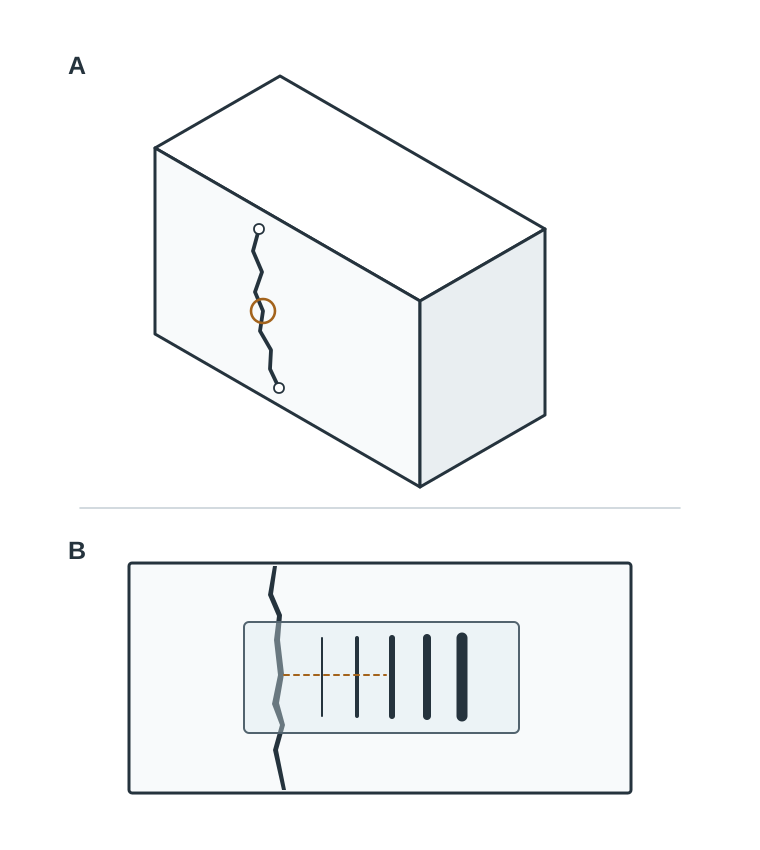 Recording a concrete crack. A locates the crack and observation point. B compares its visible surface opening with printed lines of different thickness.
How do you track change?
Keep the first sketch, photographs, measurement point and date as a baseline. Repeat the record from the same viewpoint and a similar distance. Note the date, relevant temperature or weather conditions, moisture signs, and the reading at exactly the same location. If the opening appears to change, ask whether a measurement point or displacement gauge is needed. A crack gauge tracks movement only at the point and in the direction where it is installed; its placement, initial reading and interpretation belong in a monitoring plan. Manual readings may also vary between observers. [4]
A difference between two observations is a reason to investigate, not automatic proof of structural distress or a particular cause. Changes may also reflect the measurement method, lighting, moisture or temperature.
What does appearance not tell you?
A straight, diagonal or branched crack can fit more than one mechanism. Shrinkage, temperature movement, loading, settlement, reinforcement corrosion, freeze-thaw action and chemical reactions can all cause cracking. Rust staining or a damp patch is also a clue, not a diagnosis. Betonvereniging, for example, describes cracking as a possible result of corrosion and alkali-silica reaction; FHWA’s inspection protocol asks inspectors to record moisture, efflorescence, rust and exposed reinforcement as well as crack location, length, direction and width. Neither makes a single visible crack diagnostic by itself. [2, 3]
The significance of a crack also depends on the element and its function. An opening that is mainly aesthetic in one element may have different consequences in a water-retaining structure or bridge. There is no universal threshold that lets an owner decide from one isolated reading whether a crack is safe, active or requires repair. [1]
When should you contact a specialist?
Ask a concrete maintenance specialist or structural engineer to assess the condition if the crack is growing, the edges are offset, water is leaking, rust or spalling appears, reinforcement is visible, or the crack is in a load-bearing or prestressed element. For sudden damage, falling pieces or doubt about immediate safety, keep people away and follow the site’s safety procedure.
Bring your element map, dated photographs, repeat readings and any history of earlier repairs. Ask what additional observation or test is needed, how the cause will be checked and whether monitoring is required before selecting a repair method. See also concrete condition assessment, crack injection and sealing cracks and joints.
Sources
- ACI Committee 224, Causes, Evaluation, and Repair of Cracks in Concrete Structures, ACI 224.1R-07, 2007, Chapter 2 “Evaluation of cracking”; summary and table of contents on the ACI publication page. Also ACI, “Alternative methods for measuring crack widths”, accessed 10 November 2026, on comparator/optical devices and limits of feeler gauges: FAQ. ACI, “Do we always need to repair cracked concrete?” · Elcometer 143.
- FHWA, Long-Term Bridge Performance Program Protocols, Version 1, January 2016, protocol Fld-Dc-Vic-005, §§3.5–3.7 and 6.4: recording crack location, length, orientation, surface width, possible depth and associated features. This is an inspection protocol for US bridges, not a general threshold table for buildings: protocol.
- Betonvereniging, Schademechanismen van beton, undated knowledge-base page, accessed 10 November 2026, examples of corrosion, ASR, freeze-thaw and mechanical loading as possible damage causes: article.
- FHWA, Technical Manual for Design and Construction of Road Tunnels — Civil Elements, FHWA-NHI-09-010, March 2009, §15.3.2.9, pp. 15–24–15–25: crack gauges/jointmeters, repeat readings and limitations of simple manual measurements: manual.