
Damage in an industrial floor should first be distinguished as a local defect, a joint problem or movement or distress affecting the floor more broadly. The right response depends on the floor zone, the cause and exposure to traffic, machinery, liquids and cleaning. In an operating facility, the work area must also remain safe and usable.
What damage can you see?
A spalled joint edge may relate to wheel loads, loss of support or an unsuitable joint filler. A crack may be associated with shrinkage, loading, subbase movement or a structural issue. Surface scaling or dusting may indicate a weak wearing surface, but moisture, chemical exposure or an earlier finish can also be involved. Photos and a floor plan help record patterns and change; they do not establish the cause.
Record the location relative to joints, columns, racks, drains and travel routes. Note vehicle and wheel types, exposure to water or chemicals, and hygiene or slip-resistance requirements. Where there are abrupt level changes, rapidly changing cracks or suspected load-bearing problems, arrange a competent assessment before resuming heavy traffic.
Joint, crack or repair area?
A movement joint must accommodate movement. A saw-cut contraction joint serves a different purpose, while a random crack is not automatically a joint. A rigid repair across an active joint can crack or debond again. Conversely, a spalled joint edge on a hard-wheel route may need a robust edge repair rather than flexible sealant alone. The designer should determine whether the joint function is retained, restored or changed.
A local concrete loss may suit a repair mortar if the surrounding slab is stable and repair depth, bond, curing and service loads can be managed. A coating or floor finish may improve wear or chemical resistance, but it will not solve a moving crack or deficient support. Widespread damage, structural movement or a failing base calls for investigation before selecting a product.
Working in an operating facility
Define in the scope which zones, routes and services are available, who controls barriers, how dust, noise and waste will be managed, and what temporary diversions are needed. Coordinate application and curing with temperature, moisture, ventilation and production, food-safety or fire requirements. Ask the contractor to propose sequencing, emergency access and release criteria. A rapid return-to-service claim is meaningful only when supported by the selected system and actual conditions.
How do you assess the result?
Agree in advance what will be inspected: profile and level at specified locations, interface with the existing floor, edge condition, joint width and filling, bond or other project-specific checks. Also confirm that temporary markings and barriers have been safely removed and that product records and deviations are handed over. A surface that looks even does not by itself prove bond or load capacity.
Ask what cause was identified, which joint function was preserved, what loading can resume and what maintenance inspections are needed. See also cracks in concrete and concrete patch repair.
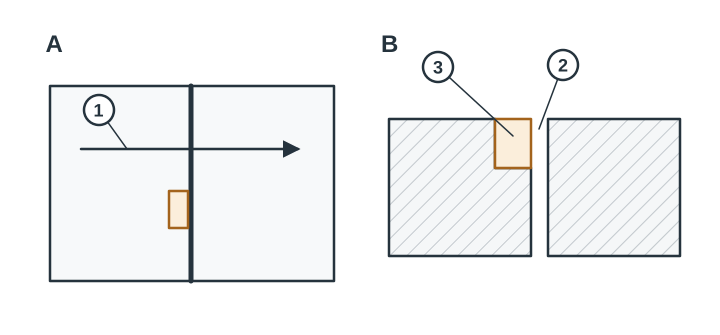 A shows the floor plan and B a section through the joint edge. 1. Traffic route. 2. Joint kept open. 3. Local edge repair.
Sources
- ACI Committee 302, ACI 302.1R-04, Guide for Concrete Floor and Slab Construction, §§3.2.5–3.2.6 (scope, joints, load transfer and floor serviceability) — Guide concerns construction; joint principles do not prescribe a repair design. Source.
- CROW-CUR, Richtlijn 1:2018, Prestatie-eisen aan gegoten dekvloeren — Explains assessment against intended floor finish; not a structural slab repair guide. Source.
- ACI, FAQ 663, The effect of joints on the durability of concrete structures — Joints can create paths for fluids and contaminants; concise explanatory reference. Source.