
Freeze-thaw damage may appear as scaling, flaking layers, fine parallel cracks or loss of cohesion. These signs are not unique to freezing: de-icing salts, corrosion, wear, poor finishing or other material reactions can look similar. The pattern helps focus investigation but does not confirm the cause. [1, 2]
Clues in the damage pattern
Note where damage starts and how it changes. Freeze-thaw or de-icer-related damage may concentrate on wet, exposed surfaces, edges and joints. Surface scaling can expose coarse aggregate; deeper deterioration may accompany map cracking or loss of cohesion. De-icing salts may contribute to scaling, but a salt-exposed area does not prove salt is the only cause. [1]
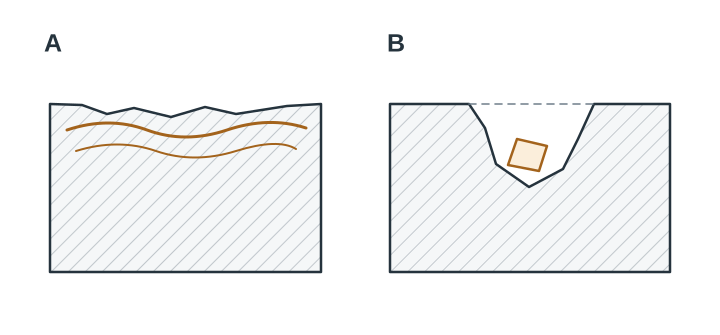 A shows shallow, layer-parallel damage as a possible freeze-thaw indication; B shows a local pop-out around an aggregate particle as a different appearance. The drawing is not a diagnosis.
What helps distinguish causes?
Record exposure, wet-dry and freezing history, de-icer use, drainage, previous repairs and progression. Compare areas with different exposure. A weak surface layer from finishing or curing can also scale; corrosion more often produces clues along reinforcement. Local pop-outs may involve an aggregate particle and are not the same as a broader freeze-thaw affected area. Appearance alone is insufficient. [1, 2]
Where the pattern is unclear or progressing, petrographic analysis of a representative sample can help examine microcracks, air voids and aggregate distress. FHWA notes that confirming paste freeze-thaw damage may require microscopic examination and that aggregate distress needs separate interpretation. This is specialist laboratory work, and the sample must be selected carefully. [1]
How should findings be assessed?
Ask which alternative causes were considered and why the samples are representative. Relate results to the damage pattern, exposure and structural details. A single core can miss local variation. If reinforcement is exposed, pieces may fall or structural relevance is possible, have safety and load-bearing function assessed separately.
See spalling and delamination, chlorides in concrete and concrete condition assessment.
Sources
- FHWA, Guidelines for Detection, Analysis, and Treatment of Materials-Related Distress in Concrete Pavements, FHWA-RD-01-163, 2002, chapter 3, “Diagnostic Features for Paste Freeze-Thaw Deterioration” and “Diagnostic Features for Deicer Scaling/Deterioration”: surface scaling, parallel microcracks, air voids and petrographic confirmation. Pavement context. Chapter.
- FHWA, Petrographic Methods of Examining Hardened Concrete: A Petrographic Manual, FHWA-HRT-04-150, 2006, chapter 4, §§4.2.3–4.2.5: scaling, weak surface layer, freeze-thaw and corrosion cracking as alternatives. Chapter.
- FHWA, Field Reference Manual for Quality Concrete Pavements, FHWA-HIF-13-059, p. 20: moisture, freeze-thaw cycling, de-icers and air voids; cautions on over-finishing. PDF.