
Carbonation is a reaction between carbon dioxide in air and constituents of hardened cement paste. It lowers alkalinity in the concrete. An indicator applied to a fresh fracture of a core can show a transition between zones with different pH, but cannot by itself establish whether reinforcement is corroding, how much steel is affected or how quickly the front is moving. [1]
What is measured?
A common screening procedure samples concrete, creates a fresh fracture and applies a pH indicator. The colour boundary is measured from the original concrete surface. The area that does not change colour is often interpreted as a lower-pH zone, but interpretation depends on indicator, sample quality and test procedure. It is a local result: moisture, exposure, cracks, concrete composition and variation within one element can affect the depth. [1, 2]
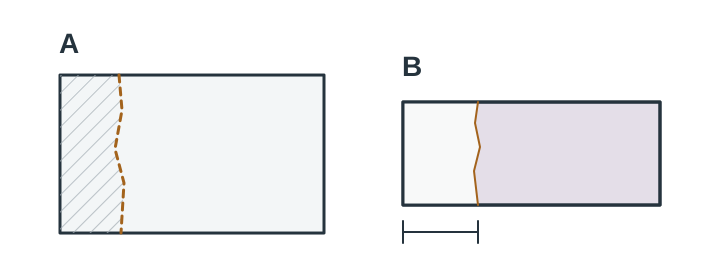 A shows the zone near the exposed face on the left. B shows the split core and the local reading measured from that original face.
How should you read the result?
Ask which surface was sampled, how the core was oriented, which indicator and procedure were used, where the reading was taken and how variability was reported. Do not compare the depth directly with nominal cover from a drawing without qualification: actual cover varies, and selected locations do not necessarily represent the whole element.
If the lower-pH zone appears to reach reinforcement, that is a reason to assess the corrosion context further. Moisture, oxygen, chlorides, cracks, cover and electrochemical conditions matter. A carbonation-depth reading alone does not establish active corrosion. Conversely, a shallow reading does not rule out chloride-related damage or another cause. [1]
A reading or an investigation question?
A single depth reading may support initial screening. Understanding distribution may require readings at several representative locations, potentially combined with cover measurement and chloride profiles. Cores give direct information at a limited point and locally damage the member; drilled-powder profiles can investigate chloride distribution with depth but do not measure a carbonation front in the same way. Petrographic examination can add information when the indicator test is unclear. [2, 3]
Have a specialist tailor sampling to the structure type, exposure, damage pattern and decision that the results need to support. Values from different procedures, indicators or reporting units are not automatically comparable.
Next step
Ask for a sketch of sampling locations and cover, the raw results and procedure, and an explanation of how uncertainty and local variation were considered. Ask what further evidence is needed before repair or monitoring is selected. See reinforcement corrosion, chlorides in concrete and concrete condition assessment.
Sources
- FHWA, Foundation Reuse for Highway Bridges, 2018, durability assessment section, p. 132: indicator test on a drilled core and interpretation of the colour zone as indicative carbonation depth; chloride profiles from powder samples at successive depths. Bridge context. PDF.
- FHWA, Bridge Preservation and Maintenance in Europe and South Africa, FHWA-PL-05-002, 2005, section on Swedish inspections: split core and apply phenolphthalein to fracture; chloride powder collected at separate depths. Example field protocol, not a general requirement. PDF.
- FHWA, Petrographic Methods of Examining Hardened Concrete: A Petrographic Manual, FHWA-HRT-04-150, 2006, chapters 3 and 8: sample preparation, microscopy and supplementary analyses for complex diagnosis. Manual.